

Advanced Manufacturing for Energy‑Related Applications
About the Pilot
Launched in 2013, the Advanced Manufacturing for Energy Related Applications in Harsh Environments (ADMA) Pilot is an innovation community dedicated to integrating the Blue Sustainable Economy value chain. Led by Emilia-Romagna and Lombardia, ADMA leverages the strategic geographic advantages of its nine Member regions, which possess a specialised ecosystem in offshore technologies, including cluster organisations, research institutions, and an advanced manufacturing base in marine renewable energy and wider offshore energy and subsea applications.
Through research, innovation, and development, ADMA’s regions are establishing themselves as global leaders in offshore renewables. By reducing dependence on conventional fossil fuels, offshore renewables enhance energy security, foster sustainable energy systems, attract investments, and drive economic growth and prosperity for the regions.
Activities & Long Term Goals
Europe’s regions pioneering in advancing Offshore Energy Value Chains.
ADMA’s regions are dedicated to deepening their knowledge and understanding of the offshore renewables sector. Feasibility studies drive breakthroughs in advanced manufacturing technologies covering design, functionality, integration, automation, materials, and communication for components and systems.
The Pilot supports demo cases to reach commercialisation by facilitating funding access for pilot activities and demonstration projects. Collaboration between larger companies and innovative SMEs stimulates sector growth and strengthens supply chains across Europe, providing new business opportunities and expansion for smaller companies.
Powering Cross-Sector Innovation.
The ADMA Energy Pilot recognises the significance of cross-cutting issues, cross-sectoral knowledge exchange and synergies with other Vanguard Initiative Pilots as well as complementary EU networks and initiatives. One notable connection is with the Hydrogen Pilot.
In a specific demo Case, the ADMA Energy Pilot envisions electricity production, both offshore and onshore, to support the production of green hydrogen. This demonstrates the interconnectedness of renewable energy generation and the potential for offshore energy to contribute to the production of clean hydrogen.
Additionally, ADMA collaborates closely with the VI Nano-enabled Products Pilot, focusing on manufacturing new materials, as those hold immense potential enhancing the performance and durability of offshore energy components and systems.
Co-Leading Regions
 Lombardia
Emilia-Romagna
Pilot Contact:
Stefano Valentini
Emilia Romagna region
Carmen Di Santo
Lombardy region
Participating Regions
Asturias
Emilia Romagna
Flanders
Friuli Venezia Giulia
Lombardia
Małopolska
Wales
Demo Cases
ADNA Energy
ADNA Energy
ADNA Energy
Latest Updates
Building Robust, Autonomous & Connected Regional Hydrogen Ecosystems, 26 October 2026
The Vanguard Initiative Hydrogen Pilot Summit brings together regional authorities, industry representatives, research organisations and innovation ecosystems from across Europe to explore how interregional collaboration can accelerate the development and deployment...
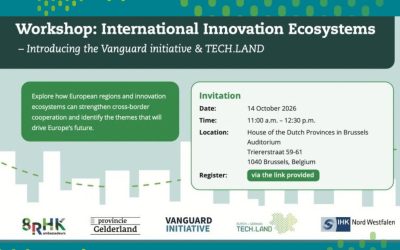
Workshop “International Innovation Ecosystems”, 14 October 2026
Vanguard Initiative together with Techland, a cross-border ecosystem between NRW and East NL, will organise an international innovation ecosystems workshop on 14 October at the Dutch House of Provinces. The aim is to bring together practitioners from this cross-border...
Smart specialisation at work: our new brief on the I3 Instrument
Vanguard Initiative has published a new brief "I3 Instrument Smart specialisation at work across Europe's regions" setting out the case for maintaining I3 as a distinct and adequately resourced instrument in the 2028–2034 Multiannual Financial Framework. The brief...
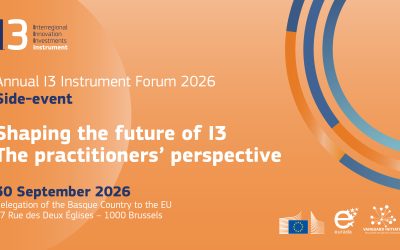
Shaping the future of I3 – The practitioners’ perspective
Vanguard Initiative and EURADA are pleased to invite you to “Shaping the Future of I3 – The Perspective of Practitioners,” a side event of the I3 Annual Forum, co-organised with the I3 Support Facility Secretariat. Event Details: 📅 Date: Wednesday, 30...

VI Industry Group Meeting, 14 September 2026
This is a member only event.

VI Annual Report 2025
The report is available here.
Demo Cases
The increase in offshore wind turbines size implies an increase in the total weight of the turbines which would reach weights that can make handling, logistics and installation tasks difficult. At the same time, materials with better characteristics against the harsh conditions of the marine environment are required.
These two points represent a big challenge for the offshore turbine manufacturers along with the reduction in the Levelized Cost of Electricity (LCoE) and operating expenses (OPEX).
Considering that the main material in offshore wind turbines is steel, the goal of this democase focuses on the substitution of the commonly used steels in offshore wind turbines by steels with advanced mechanical properties in order to develop lightweight solutions, better protection against corrosion and increase durability.
The best components of the offshore wind turbines for replacing will be determined and the best steel to be used will be designed. Feasibility studies will be undertaken, modelling of components will be carried out and testing in sea conditions will take place.
Participating regions
Asturias – Dalarna – Basque Country – Flanders
Demo Cases
The goal is to enable adhesive bonding as alternative joining method in the primary structure in shipbuilding and offshore constructions. Steel and composites can be bonded using adhesives, forming a hybrid (steel-composite) joint that presents several advantages with respect to bolted and welded joints. Despite of the many benefits of composite and hybrid joints, the lack of correct guidelines for approval and design has prevented their uptake by the maritime and offshore industry. This is partly because the long term behaviour and failure of hybrid joints is not yet understood.
Demo Cases
The ‘Power Transfer in the Sea’ project brief focusses on integrating offshore renewables at sea, the use of offshore energy to produce alternative vectors, including storage, as well as power for related industries at sea, among others. In that respect integration with onshore activities (port) and energy distribution (including green hydrogen production) is taken into account.
Pilot Contacts
Stefano Valentini
Emilia Romagna region, primary contact person stefano.valentini@art-er.it
Pilot Contacts
Carmen Di Santo
Lombardy region, secondary contact person c.disanto@confindustria.lombardia.it